In short: A coworking space is a professionally managed workplace where individuals and teams share access to workspaces, meeting rooms, amenities, and on-site support without taking on the responsibilities of operating a traditional office. It’s designed to give people somewhere productive to work—whether that’s for a day, every Tuesday through Thursday, or even weekends.
That’s the definition.
But it’s also… incomplete.
How Does a Coworking Space Work?

Somewhere over the past decade, “coworking” became one of those words everyone seems to know—until you ask what it actually means.
Depending on who you ask, it’s…
- a room full of freelancers
- startups pitching each other over oat milk lattes
- people quietly working with headphones on
- a replacement for an office
- a place you drop into once a month
- or just…better Wi-Fi than your apartment.
The funny thing is, all of those people are describing coworking.
None of them are describing it particularly well.
Because coworking isn’t really about desks.
It’s about removing everything that gets in the way of having a good workday.
 The best workspaces don’t ask you to think about the workspace. They let you think about your work.
Why Do People and Companies Choose Coworking?
Not because offices disappeared. Because work changed.
Today, very few hybrid teams work exactly the same way every day.
Some employees come in twice a week. Some travel constantly. Some companies are hiring in cities they’ve never had an office in before. Others have realized they don’t actually need forty assigned desks just because they employ forty people.
Commercial real estate has started responding to that reality. According to CBRE’s 2024 Americas Office Occupier Sentiment Survey, companies continue to prioritize flexibility in their office portfolios. Nearly half of occupiers are exploring shorter lease terms, while 58% are planning for greater flexibility to expand or contract space as business needs change.
Coworking didn’t create that shift. It simply became one of the ways businesses respond to it. Hybrid work is a big part of that story, but it’s far from the only one.
How Does a Coworking Space Work?
This is where most articles start listing amenities. Let’s do something more useful.
Imagine it’s 8:42 on a Tuesday. You arrive. You grab a coffee. Answer a few emails somewhere quiet. At 10:00, a client unexpectedly wants to hop on Zoom. Instead of taking the call from your car—or apologizing to everyone at the coffee shop—you step into a phone booth. Around lunch, two coworkers meet you to plan next quarter. You book a meeting room. By 3:00, everyone’s heads down again.
Different spaces.
Different kinds of work.
Same workday.
That’s coworking.
Not because of the furniture. Because the environment changes with the work.
What we’ve noticed…
“Something that I’ve seen Members not ask or acknowledge much in the beginning—but then come to always use for the options—are the phonebooths. That ability to hop in, take a call, take five. I think if you asked any Member of ours, at least, where they spend their most time it’s in a phone booth, so the cozier we can keep them, the better.”
—Dakota Gonzalez, Assistant General Manager, Chicago
Who Uses Coworking Spaces?
 There isn’t one way to use a coworking space. That’s rather the point.
Short answer? Just about everybody. A common misconception is that coworking is for one kind of person. But it can be any kind of workplace. On any given day, that workplace might include…
- The consultant: Somewhere professional to meet clients without committing to permanent office space.
- The growing startup: A place to collaborate now while keeping the flexibility to grow—or pivot—later.
- The hybrid team: Employees who need a consistent place to gather a few days each week without maintaining more office than they actually use.
- The traveling employee: A productive workday between flights, customer meetings, or regional offices.
- The company entering a new market: Testing a city before deciding whether a permanent office makes sense.
What Should You Look For in a Coworking Space?
I’d argue you’re asking the wrong question. Or at least, I find it’s usually answered the wrong way. Most comparison articles start with coffee, internet speed, and conference rooms. Those matter. But they’re table stakes.
A better question is:
Does this place make work easier?
Can I focus?
Can I take a confidential call?
Can clients find the front door without getting lost?
When something goes wrong, do I know who can help?
Do I have somewhere different to work when my day changes halfway through?
We asked some experts within our walls what they consider to be workspace features people think they need before moving in, and what they consistently underestimate (after 14+ years of getting to know the industry):
What we’ve noticed
Peter Feyster, Principal Project Manager:
Companies often overestimate how much lounge space they need, soft seating looks inviting, but oversized lounge areas tend to go underused, while a mix of softer chairs and kitchen-table-style spaces gives people more comfortable ways to connect and work. What they consistently underestimate is the impact of great food. It would probably surprise people what percent of our members open our app just to check the week’s breakfast and snack menu.
Natalie Birren, Sr. Director of Coworking, New Products:
A support staff, like ours, goes underestimated—and how much having a familiar face to greet you and your team by name every morning, make sure your team has everything they need to be successful, really impacts your day. In a great way. That connection and feeling of being taken care of makes your work actually feel better.
That’s what separates workspace from work experience.
Member Perspective

Furthermore, we asked Industrious members which parts of their workspace most consistently shape a better workday. Interestingly, the answers weren’t flashy. They were practical, too.
Good design. Reliable technology. Helpful staff. Spaces that support different kinds of work. It turns out people remember how a place made work feel.
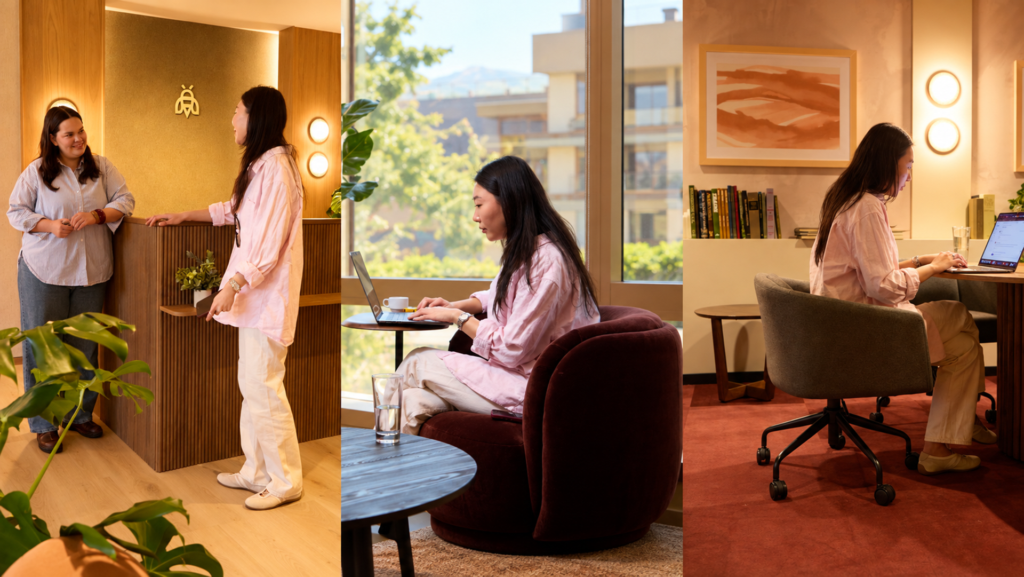 The best coworking spaces give you somewhere to go when the work changes. Because it usually does.
What Is Included in a Coworking Space?
Once again, we’ll skip the amenities for a moment and talk about outcomes.
| You need to… | A coworking space typically provides… |
| Focus | Quiet workspaces and comfy seating |
| Take a private call | Phone booths or enclosed rooms |
| Meet with clients | Reservable meeting rooms |
| Stay productive | Reliable Wi-Fi and workplace tech |
| Reset | Kitchens, lounges, coffee, refreshments |
| Get help | Hospitality and on-site staff |
(Amenities vary by provider and location.)
For more information about building amenities, transit options, and capacity at coworking spaces nearby, you can search Coworking locations here.
When is Coworking the Right Choice
This is worth saying because not every team needs coworking. If your business requires…
- permanent dedicated Meeting Rooms
- specialized equipment
- highly customized branding
- significant secure storage
- sensitive legal or financial work happening all day
…you may be happier in a Suite or a Private Office nearby. But, hey, that’s not coworking falling short. That’s your business evolving. The best workspace is the one that matches the way you actually work.
Which Type of Workspace is Right for You?
| If you need… | Consider… |
| A productive day away from home | Day Pass |
| A regular workplace each week | Coworking Membership |
| Privacy and consistency | Private Office |
| Dedicated space for a larger team | Suite |
| Space for one meeting | Bookable Meeting Rooms |
The goal isn’t choosing the “best workspace near me.”
It’s choosing the right one.
What Should You Ask Before Choosing a Coworking Space?
I’ll answer as someone who’s spent a lot of time talking with the people who run them.
- Where would I take a private call?
- How easy is it to book meeting space?
- What does this place feel like on its busiest day?
- If my team doubles—or shrinks—what happens next?
- Who do I go to when something inevitably doesn’t work?
You’ll learn more from those answers than you will by counting espresso machines. For a fuller perspective on what our team—as experts in the field—would look for when touring a new coworking space for the first time, you can check it out here.
How Industrious Thinks About Coworking
Every coworking company offers desks.
Some offer coffee.
Some offer meeting rooms.
We think those are the starting point.
Our approach has always been to ask a different question:
What makes a workday feel supported?
Sometimes that’s thoughtful design.
Sometimes it’s hospitality that notices what you need before you ask.
Sometimes it’s simply knowing the meeting room technology will work because someone already tested it.
That’s why we think about coworking less as shared space and more as a workplace that’s intentionally operated. Because the goal isn’t giving you somewhere to sit. It’s giving you the best options where you can actually get your best work done.
One Last Thought
People spend a surprising amount of time comparing square footage, amenities, lease terms, and coffee. That’s totally fair. Those things matter.
But after talking with workplace designers, member experience teams, and hundreds of members over the years, I keep coming back to a simpler question:
Will this place make my workday easier?
Not prettier. Not trendier. Not more impressive on Instagram. Just…easier?
Because the best workplaces have a funny way of disappearing into the background.
You’re not thinking about where to take a call. Or whether the Wi-Fi will cooperate. Or who’s going to help your client find the conference room.
You’re thinking about the work itself. To me, that’s what coworking is at its best. Not shared desks. Shared responsibility for making work feel a little more human.
You can find plenty of coworking locations nearby—all over the world. And Industrious is always happy to answer your questions until you find what’s right for your goals.
Reviewed for workplace strategy by Natalie Birren, Senior Director, Product & Innovation at Industrious