In short: Coworking supports hybrid teams by letting companies match their workspace to where employees are, how often they come in, and how the team changes over time. Instead of committing every employee to the same kind of office, a company can combine shared workspace, memberships, Private Offices, Suites, and meeting space across different cities.
Hybrid work would be much simpler if every team looked the same.
Ten people. One city. Everyone in Tuesday through Thursday. Done.
That just isn’t how most teams work anymore.
Maybe 10 employees are based in New York, two are in Chicago, and one is in Austin. Some people come in three days a week. Others need an office once a month. Six months from now, the Austin team might have five people.
The workplace has to keep up.
That’s where understanding what a coworking space is can become particularly useful.
Why Do Coworking Spaces Work for Hybrid Teams?

Coworking works well for hybrid teams because it gives companies flexibility across the three things that tend to change most: headcount, geography, and how often people actually use an office.
The point isn’t simply to have “less office.” That’s often how hybrid gets framed, and I think it misses the point. It’s about having the right amount of office, in the right places, for the team you actually have.
And the variation isn’t hypothetical. Gallup’s research into hybrid work shows around 52% of remote-capable employees work a flexible hybrid schedule, approximately 27% work exclusively remote, and roughly 21% work fully on-site.
In other words, “hybrid” may describe the policy. It doesn’t necessarily describe any one employee’s workweek. That’s where your workplace strategy gets interesting.
- Headcount changes
Hiring plans change. Teams reorganize. A department that needs six desks today might need 12 next year.
With a traditional office, those changes can create an awkward choice: pay for space you don’t need yet or risk outgrowing the space you have.
Flexible workspace gives companies more room to adjust.
A growing team may be able to move into a larger office or Suite within the same location. A smaller team may shift into a different setup. And a company testing a new market can start small before deciding whether a larger footprint makes sense.
- Teams aren’t always in one city
Hybrid work is also, somewhat inconveniently, a geography problem. Your employees don’t always live in the same places your office strategy was built around.
A company might have its largest group in New York, a few employees in Chicago, and one employee in Austin. Giving all three markets the exact same workspace probably wouldn’t make much sense.
Instead, the setup could look something like this:
| Team need | Possible workspace | Why it fits |
| 10-person team in NYC | Suite | Dedicated space for a larger team that collaborates regularly |
| Two employees in Chicago | Private Office | A smaller, consistent home base |
| One employee in Austin | Access Membership | Recurring workspace without taking on more space than one person needs |
| Employee traveling to another city | Day Pass or Meeting Room | Workspace only when the trip creates the need |
That’s one of the more useful things about coworking for distributed teams: flexibility doesn’t have to mean giving everyone the same thing.
It can mean giving each person or team the workspace that actually fits.
Flexible Workspace Can Change When the Business Does

The bigger advantage of flexible terms is what happens after the initial workspace decision. Because the initial decision is rarely the last one.
A company enters a new city. Hiring picks up faster than expected. A team that used to come in twice a month starts gathering twice a week. Another department goes fully remote.
Those changes shouldn’t require rebuilding the entire workplace strategy from scratch.
Coworking can make it easier to:
- Add workspace as local headcount grows
- Move into a larger Private Office or Suite
- Reduce space when a team gets smaller
- Give individual employees recurring coworking access
- Add workspace in a new city
- Use Day Passes or Meeting Rooms for occasional needs
The useful word here really is flexible.
Not flexible in the abstract. Flexible when something actually changes.
How Much Office Space Does a Hybrid Team Actually Need?

There’s another problem with designing one office solution for an entire hybrid company:
People use it differently.
One employee might work from a coworking space every Tuesday and Thursday. Another mostly works from home but needs somewhere professional for client calls. Another travels frequently. Another works near the company’s main office but joins a different location when meeting with a regional team.
Those are four different workweeks.
For employees who need recurring workspace, a membership may make sense. For someone who only needs space occasionally, a Day Pass might be enough.
For companies, the important part is looking at actual usage rather than assumed usage.
How often does this employee really need workspace?
Where?
And what do they need to do when they get there?
Those questions usually tell you more than simply counting employees.
Coworking Spaces Can Give Distributed Teams More Consistency
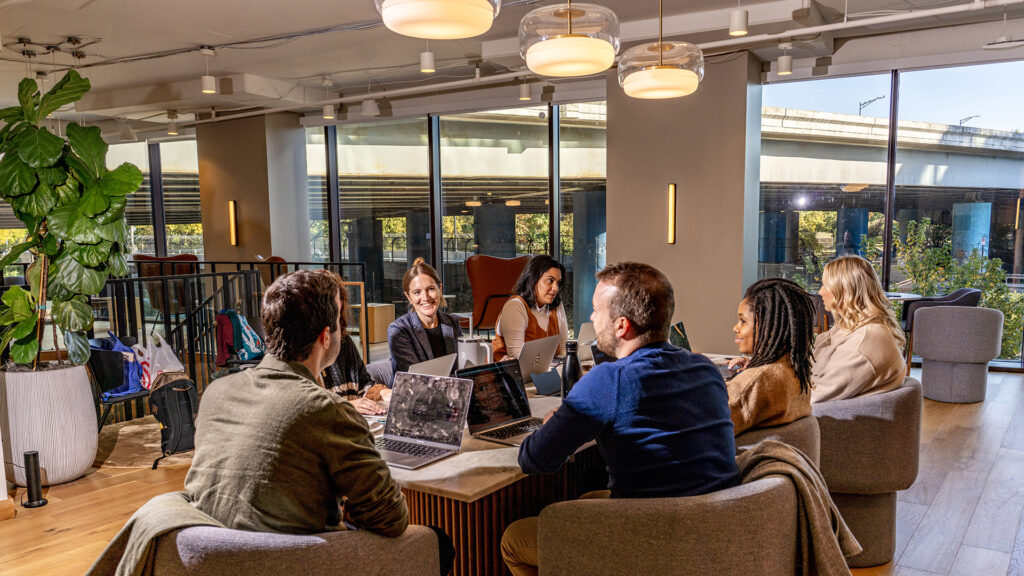
There’s an assumption that having employees in multiple coworking locations makes the workplace feel less consistent.
It can actually solve the opposite problem.
Without a workplace strategy, hybrid employees often create their own.
The New York employee goes to the office. The Chicago employee works from the kitchen table. The Austin employee takes a client call from a coffee shop. Someone traveling spends six hours in a hotel lobby.
Technically, everyone is working.
But they’re not having remotely the same workday.
A well-run coworking network can give distributed employees a more reliable baseline: somewhere professional to focus, take a call, meet another person, get online, and get help when something isn’t working.
The location might change.
The expectation of what a productive workday looks like doesn’t have to.
Planning workspace for a hybrid team? Explore Industrious coworking memberships, private offices, and suites.
What Should a Hybrid Team Consider Before Choosing Coworking?
Start with how your team actually works, not how you think they should work.
Five questions usually get you pretty far:
- Where are your employees?
Look at the cities where people actually live and work.
- How often does each group need workspace?
A team coming in three days a week has a different need from someone coming in twice a month.
- How much privacy does the work require?
Shared workspace may be enough for some employees. Others may need a Private Office or Suite.
- How much could the team change?
Consider hiring plans, new markets, reorganizations, and the possibility of needing more or less space.
- How many locations do employees need access to?
One home base and a multi-city workplace program solve different problems.
This is where flexibility becomes practical.
You’re matching workplace to the team instead of asking the team to fit whatever workplace you already have.
Is Coworking Right for Every Hybrid Team?

No.
Some companies need highly customized environments, specialized equipment, significant secure storage, or permanent dedicated space. Others simply have enough employees in one market that a larger dedicated office makes more sense.
Coworking is useful when flexibility is actually valuable.
The question isn’t whether coworking is better than a traditional office.
It’s which setup makes sense for the way your team works right now, while giving you enough room to change what happens next.
A Better Hybrid Office Doesn’t Have to Be One Office
Hybrid work changed more than how many days people commute.
It changed what a company needs its workplace to do.
One team may need somewhere to gather. One employee may need somewhere to focus. Another city may need room to grow. And six months from now, all three needs could be different.
The best hybrid workplace strategy accounts for that from the beginning.
Not one office for everybody.
The right workspace, wherever the work happens.
Find an Industrious coworking space.