A new reservable collaboration space at Industrious 190 Bowery, designed for the way teams actually brainstorm, break out, regroup, and work together now.
“That Space Felt Very Confining”
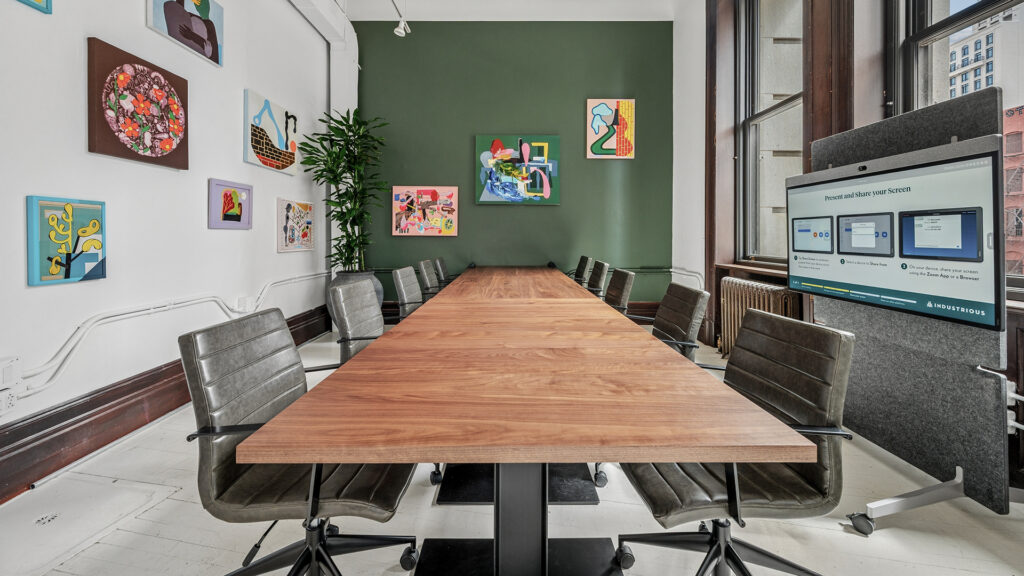
Traditional meeting rooms have their place.
They work well when everyone needs to look at the same screen, review the same numbers, or make their way through a focused agenda. We love that. For the right kind of meeting, the format makes sense: a table, chairs, four walls, a screen at the front.
But not every great meeting works that way. Not anymore, at least.
Some days ask more of a team. A planning session stretches into a brainstorm. A brainstorm turns into side conversations. Someone needs to sketch an idea. Someone else needs to step away with a teammate and solve a problem in the corner. The group breaks apart, comes back together, changes direction, gets stuck, gets unstuck, and eventually finds its way to the decision it came in to make.
That kind of work is harder to contain. And for Natalie Birren, the Sr. Director of Product & Innovation at Industrious, the idea behind The Parlor at 190 Bowery started with that exact tension.
“I led an offsite for my team back in February,” she says. “It was over two days and really focused on creating a new thing. That required a lot of brainstorming, a lot of creative thinking, and a lot of discussion.”
Yes, there were moments when the traditional meeting room worked. Looking at numbers on a screen, staying close to the information, or focusing on a single topic. But a few hours in, when the team needed to move, think out loud, and work through ideas together, the room started to feel too small for the work.
“For those moments where we wanted to be ideating creatively, people wanted to be moving around the room, having discussions,” Birren says. “That space felt very confining.”
Not every great meeting fits inside a conference room.
That belief sits at the center of The Parlor, a new kind of reservable collaboration space at Industrious 190 Bowery designed for the full arc of team work: settling in, spreading out, breaking off, regrouping, deciding, and leaving with momentum.
The Space Has to Work Harder Now
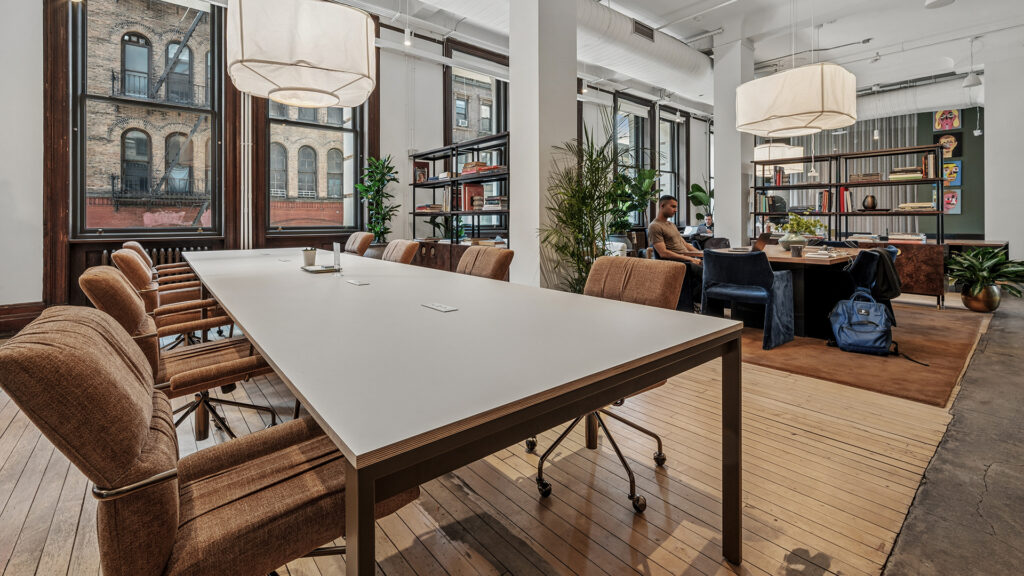
What’s changed over the last few years isn’t just where people work. It’s how—and more importantly, why—they come together in the first place.
For a long time, the office was built around routine presence. Teams gathered because that’s simply where work happened. By default. But now, for a growing number of companies, time together has become more intentional. People aren’t necessarily commuting in to answer emails they could’ve sent from home. They’re coming together for moments that benefit from being together: planning sessions, workshops, onboarding, creative reviews, relationship-building, decision-making, offsites, collaboration that gets messy before it gets clear.
And as these moments matter more, the space starts to matter more, too.
“The Parlor was about creating a space that could really match the energy of the work that you are trying to do,” Birren says.
That idea became the starting point for The Parlor at 190 Bowery. Not a lounge. Not a boardroom. Not another meeting room with softer furniture. Something in between: an open, reservable collaboration space designed around the way teams naturally move, think, and interact over the course of a day. This time with high design.
Instead of treating collaboration like a static activity that happens seated around a table, The Parlor was designed around motion. Whiteboarding. Sidebars. Breakout conversations. Spreading materials across surfaces. Reconfiguring the room without having to formally “reconfigure the room.” The kinds of behaviors that happen organically when people are comfortable, energized, and actually engaged with one another. Take-your-shoes-off energy without taking your shoes off.
“There is not anything that exists for that,” Birren says. “You want to be in an environment that has energy and buzz, like a coffee shop, but that is really functional for working.”
That middle ground is what makes The Parlor interesting and more intentional than pulling a few chairs together and hoping for the best. And that’s what Industrious feels is the bigger shift underneath all this: the workplace no longer just needs to contain collaboration. Increasingly, it needs to actively support it.
Designed Around Collaboration, Not Containment
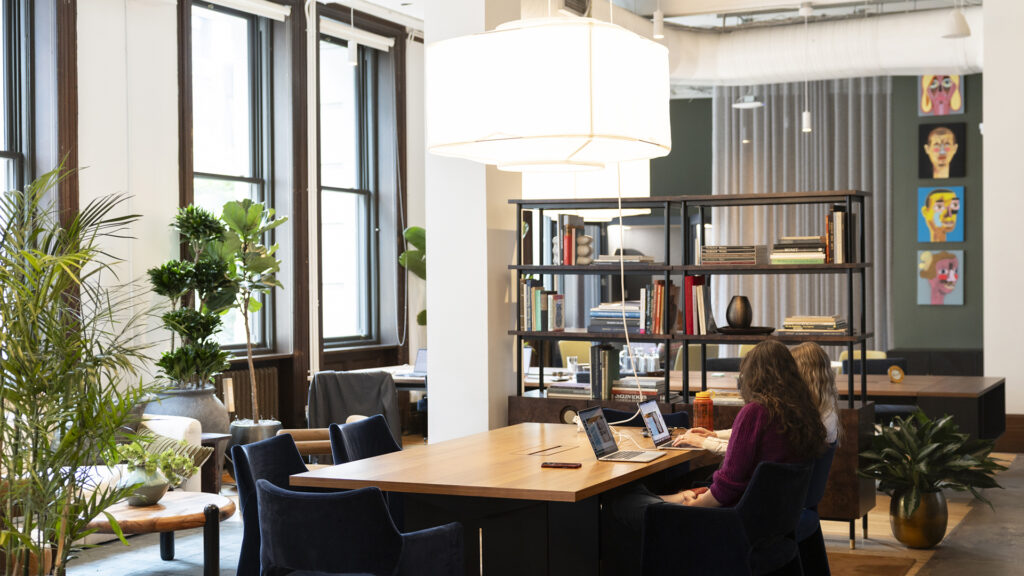 Photo: Laura June Kirsch
“Those two layers of anticipatory service and just straight-up functionality are really important,” Birren says. That philosophy shaped nearly every part of the experience at 190 Bowery.
Instead of designing around a single table and a single posture for eight straight hours, The Parlor was designed around movement. Teams can settle into lounge seating for conversation, move into more focused work setups throughout the day, break into side discussions without leaving the space entirely, then regroup again when it’s time to align. Whiteboards, AV tools, breakout moments, adaptable layouts, and reservable zones all support that rhythm without forcing the day into a rigid format.
The reservable spaces are as follows:
Open collaboration areas like Parlor A and Parlor B give teams a more relaxed, energetic environment for working sessions, brainstorming, and colocating together throughout the day. More private setups, like Conference Room 2A and Parlor C, support larger offsites, presentations, workshops, or moments that require a little more structure without losing the openness and flow that defines the broader experience.
“One of the things meeting rooms are missing,” Birren says, “is that if you and I needed to sidebar on something, we would need a breakout space to do that.”
The Parlor was designed to anticipate those moments instead of treating them like interruptions. The seating is intentionally ergonomic. The lighting changes throughout the day. Music shifts with the rhythm of the space. Teams can reserve areas knowing they’ll have room to spread out and settle in rather than compete for space in a crowded common area. Every detail, from the layout to the sensory experience, was built around a simple idea: if people are gathering more intentionally now, the environment should rise to meet that intention.
“When you walk in, our team knows to expect you and can guide you exactly to where you want to go. So you feel anticipated, you feel taken care of, and you feel superhuman.”
“The Coolest Building In New York”
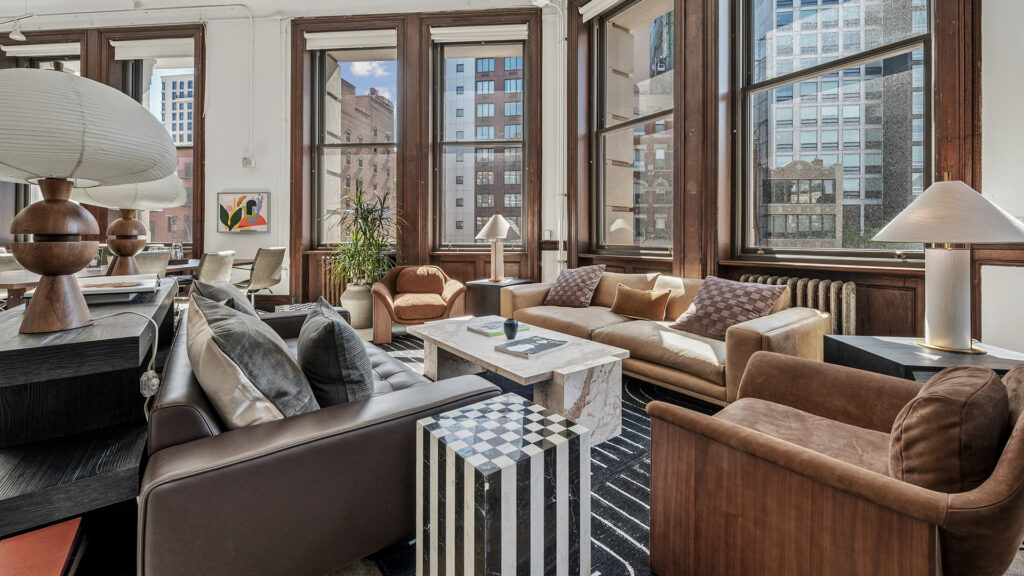
The Parlor could have been tested anywhere. But according to Birren, 190 Bowery was the place that made the idea click into focus.
“We needed the right place to do it,” she says. “The right balance of energy and light to make it feel really special.”
Long before it became an Industrious location, 190 Bowery carried its own creative gravity. The landmarked building served as the longtime home and studio of photographer Jay Maisel, whose decades-long stewardship transformed the space into something part workspace, part archive, part living work of art. Rather than erase that history, the team behind The Parlor chose to work in conversation with it.
From the beginning, the design approach centered less on reinvention and more on preservation and stewardship.
“We were really intentional about not wanting to cover it up,” Birren says. “We wanted it to be a part of it.”
That thinking shows up throughout the space. Artwork was treated as a core part of the experience early in the process, not a finishing touch added later. Industrious worked with art consultant DB Burkeman to help shape a collection and visual language that honored both the building’s history and the surrounding neighborhood. Music became part of the environmental design too, with playlists developed specifically for the space in collaboration with The Playlist Generation to reflect different eras and energies connected to downtown New York.
“The Parlor should be a sensory experience,” Birren says.
Natural light floods the floor throughout the day. Original architectural details remain intact. Even the building’s historic elevator cab was transformed into a viewing room for a documentary about the property itself—a decision that intentionally dedicates usable square footage to the story and cultural significance of the building.
“We are taking real estate to do that in our space because we think that it’s important,” Birren says. “We want to be good stewards of a space that we feel is historically significant.” That sense of character matters because The Parlor isn’t really trying to create a neutral environment. It’s trying to create one that people remember.
“If our thesis here is that teams do better work together in open spaces,” Birren says, “there was no place more perfect than the coolest building in New York.”
More Than Attendance
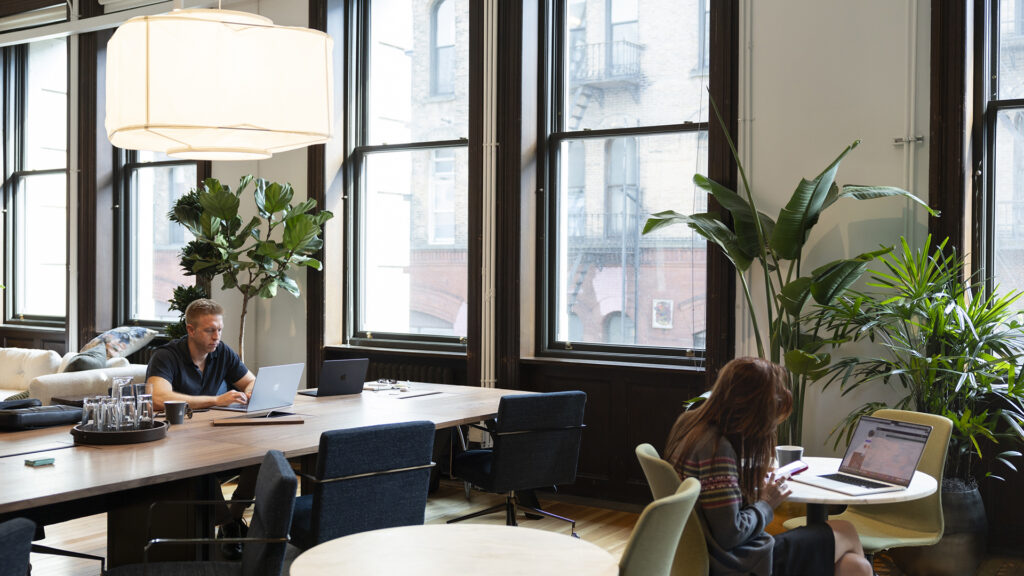 Photo: Laura June Kirsch
For all the conversation around RTO over the last few years, much of it has centered on attendance: how often people come in, how many days teams spend together, whether desks are occupied. But Birren believes that kind of framing misses the more important question:
“If you focus on just coming into the office without focusing on how people are connecting and engaging with each other,” she says, “you’re missing the point.”
The Parlor wasn’t designed around the idea that people should simply spend more time at work. It was designed around the belief that time together should feel meaningful when it happens. That collaboration works better when people feel comfortable enough to move, energized enough to contribute, and connected enough to actually engage with one another.
And to be honest, it’s also got to be worth the commute.
In some ways, that’s what makes The Parlor feel less like a new room type and more like a response to a larger shift in how work fits into people’s lives now. Flexibility matters. Working from home matters. Balance matters. But so does the feeling of spending a day alongside other people and leaving more energized than when you arrived.
“I believe that when people are engaged and connected with each other, they are happier,” Birren says. “Humans are not solitary creatures.”
That doesn’t necessarily mean being in an office five days a week. But it does mean creating environments that make gathering together actually worth it. For Industrious and the entire team behind 190 Bowery, the bigger idea underneath the building was not simply designing spaces where people can work, but designing spaces where people genuinely want to.